

Collection English yew specimens
Each piece One of one
Supplied as A field-grown rootball
Price On application
English Yew Specimens — Field-Grown
Decades to grow. Only one of each.
One-off English yew specimens: rings, domes, spirals, cloud trees and tiered pagodas from 0.7m to 3.6m, each shaped over many years by specialist family growers in Europe. Every piece is the exact plant in its photographs, lifted as a rootball in hessian and wire, then craned into place between November and March.
Price on application · HIAB crane delivery quoted to your postcode
One of one · Price on application
The exact plant in every photograph
Each is a single field-grown English yew, and when it’s sold, it’s gone. Filter by where it will stand or by height. Price and HIAB crane delivery are quoted to your postcode.
22 pieces · 22 available
-
 AugustusTiered Mushroom on Dome3.6m × 1.85mPrice on application
View this piece
-
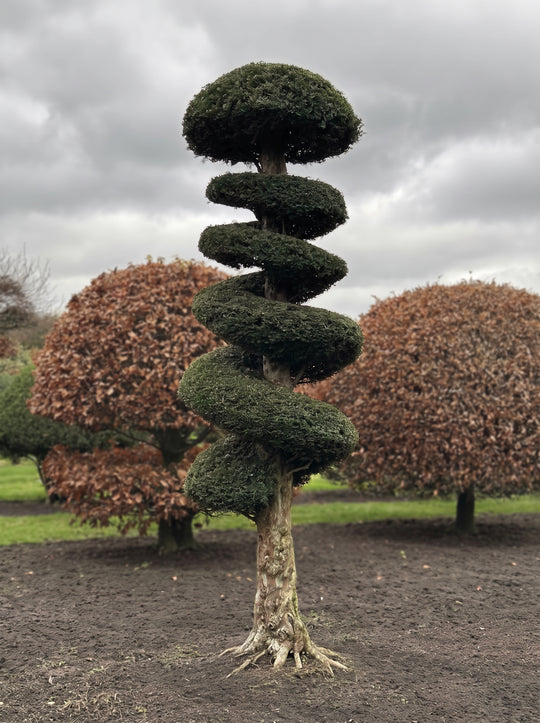 CorinSpiral Standard3m × 1mPrice on application
View this piece
-
 GideonPyramid2.95m × 1.35mPrice on application
View this piece
-
 EdmundTiered Pagoda on Dome2.9m × 1.5mPrice on application
View this piece
-
 TamsinCloud Tree on Drum2.65m × 1.45mPrice on application
View this piece
-
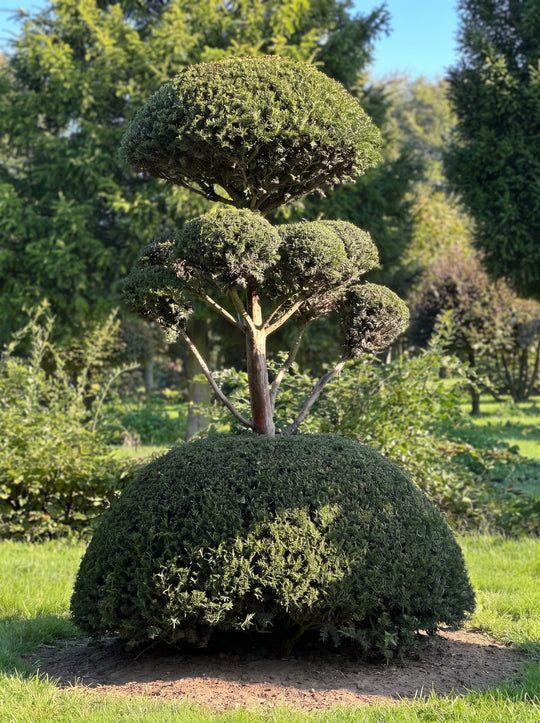 MabelCloud Tree on Dome2.65m × 1.75mPrice on application
View this piece
-
 OttilieTiered Pagoda on Dome2.65m × 1.5mPrice on application
View this piece
-
 IsoldeTiered Pom Pom Standard2.55m × 1.6mPrice on application
View this piece
-
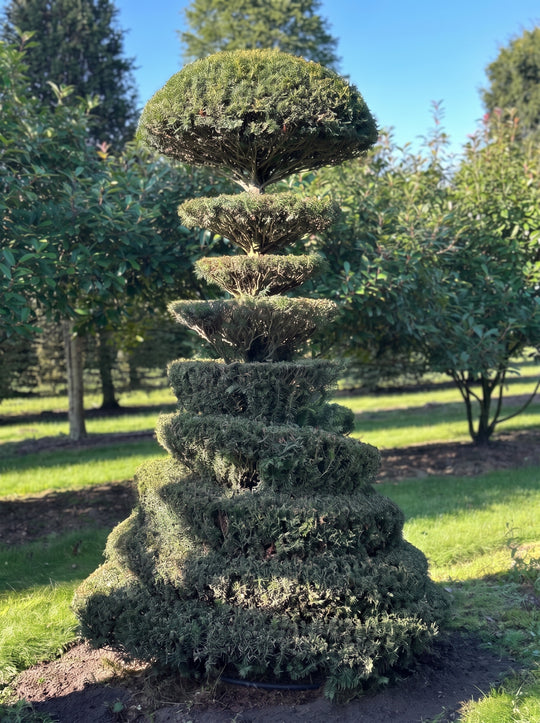 FlorianSpiral Pagoda2.5m × 1.5mPrice on application
View this piece
-
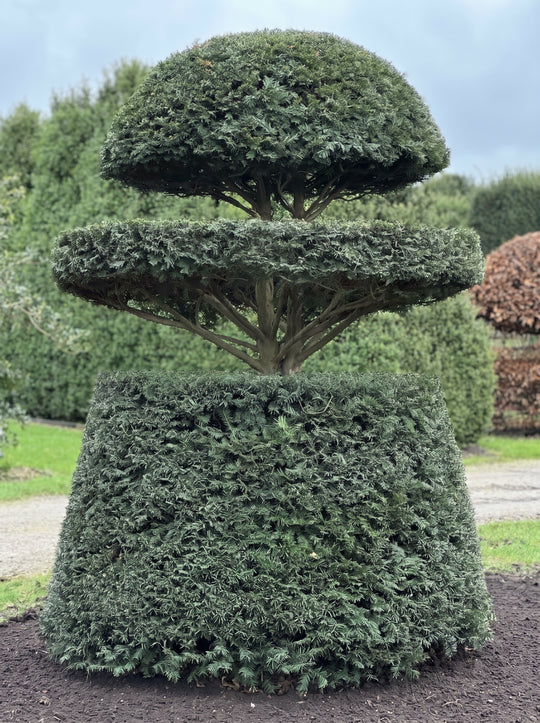 CosimoTiered Cloud on Drum2.45m × 1.7mPrice on application
View this piece
-
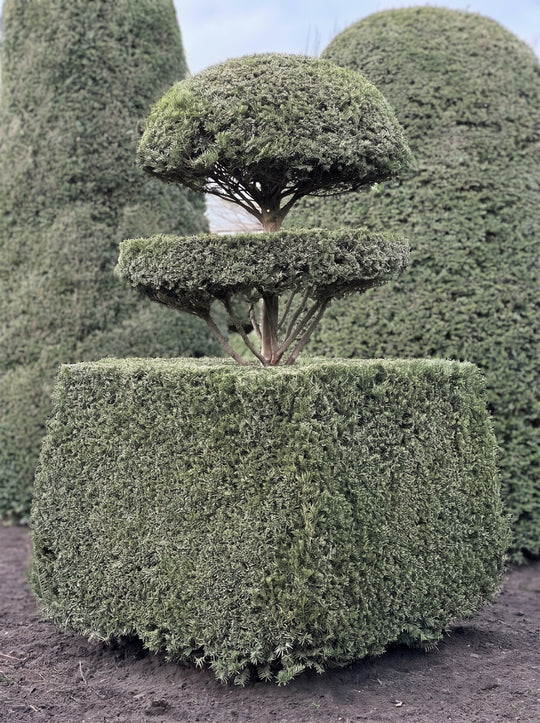 AmbroseTiered Cloud on Block2.4m × 1.4mPrice on application
View this piece
-
 RussetMulti-stem Mushroom2.25m × 1.8mPrice on application
View this piece
-
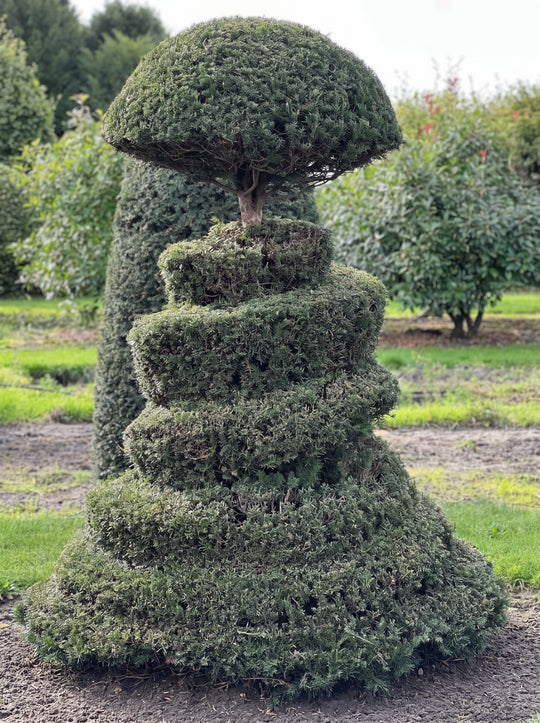 SeverinSpiral with Mushroom Crown2m × 1.6mPrice on application
View this piece
-
 PipLollipop Dome1.95m × 1.5mPrice on application
View this piece
-
 RupertMushroom on Block1.9m × 1.4mPrice on application
View this piece
-
 HollisMulti-stem Mushroom1.85m × 1.85mPrice on application
View this piece
-
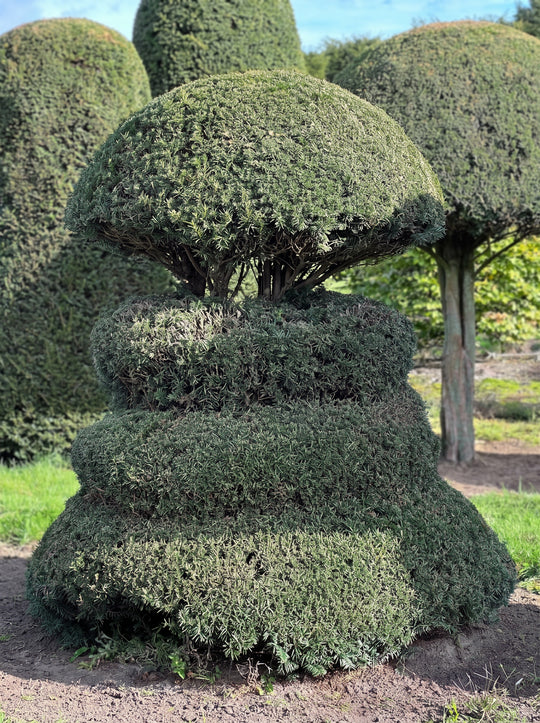 BastianSpiral with Mushroom Crown1.75m × 1.6mPrice on application
View this piece
-
 HiroCloud Tree (Niwaki)1.65m × 2.15mPrice on application
View this piece
-
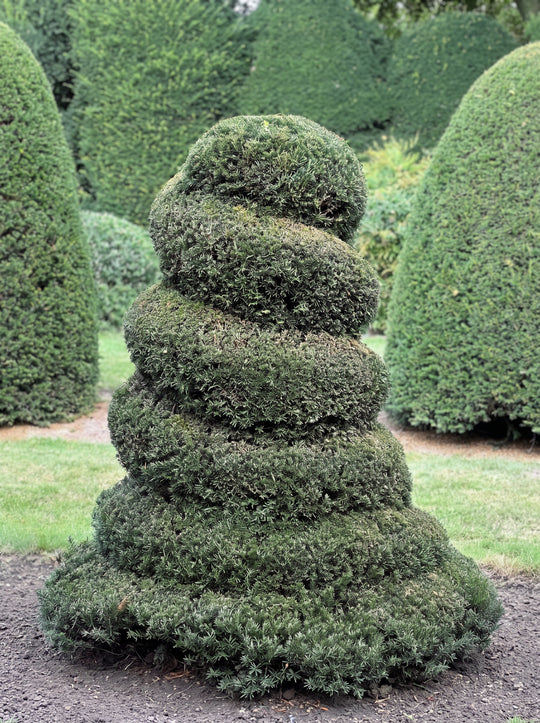 WilderSpiral Cone1.65m × 1.35mPrice on application
View this piece
-
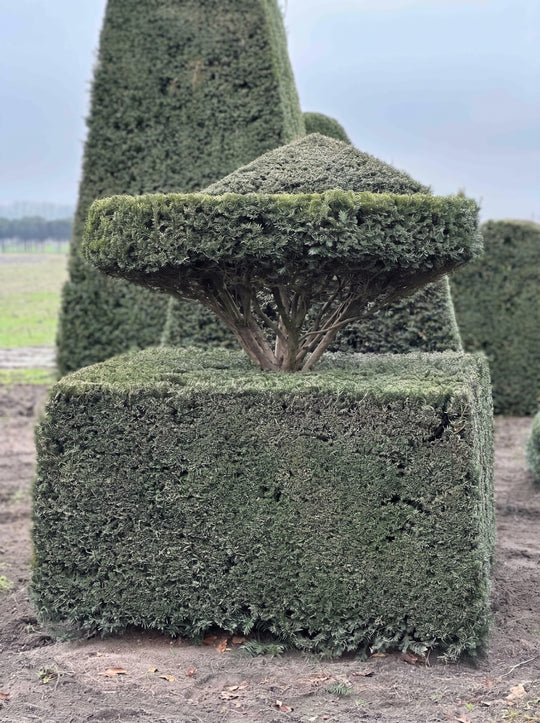 LindenParasol on Block1.6m × 1.6mPrice on application
View this piece
-
 OttoDome0.95m × 1.6mPrice on application
View this piece
-
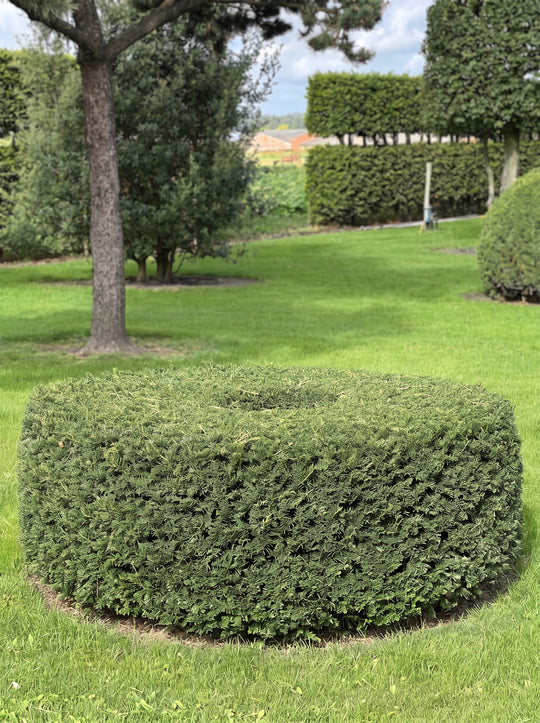 HaloRing0.7m × 1.7mPrice on application
View this piece


No piece matches these filters
Try another height or placement, or email Horatio with the height and setting you have in mind.
One plant.Three steps.
Every piece is price on application: you enquire, Horatio quotes, a crane delivers.
Enquire with your postcode
Choose a piece in the collection above and send the enquiry form on its page, with your delivery postcode. There is no basket and nothing to pay at this stage. Specimens are price on application because two things move: grower prices change from season to season, and the cost of crane delivery depends on where the plant is going.
One price, and photographs for your approval
Horatio replies personally — within 24 hours where we can, always within 48, Monday to Friday — with one figure: the piece and its HIAB crane delivery to your postcode, together. Before it travels, the plant is inspected, photographed for your approval and its rootball measured, so you see exactly what is coming. One invoice covers the piece and its delivery, with a secure payment link.
Craned into place, November to March
Specimens travel as a field-grown rootball wrapped in hessian and wire, and go into the ground in rootball season, November to March, while the plant is dormant. The crane lorry lifts the rootball off and sets it down as close to the planting spot as it can reach. Please don't book contractors, landscapers or tradespeople until your specimen has arrived: dates can move, and we can't cover contractor costs if they do.
Where a specimentakes the stage.
Three settings, and the pieces that suit each.
 Image 01
 Image 02
 Image 03
A courtyard, walled or paved
Enclosed by walls, one sculptural piece becomes the centre of the room, and every window and doorway looks onto it. Low, wide pieces suit a courtyard you look down on from a terrace or an upstairs window: Halo, the 0.7m ring, reads best from above, and Otto, the 0.95m dome, has the weight and calm of a garden boulder. Where there is height to fill, a cloud tree or a multi-stem mushroom — Hiro at 1.65m, Hollis at 1.85m — brings shape without closing the space in.
Entrances & pathways
Upright, contained shapes mark an arrival without blocking it: beside a front door, at a gateway, or at the far end of a path, where they close the view. Spirals and standards do it best — Wilder's spiral cone at 1.65m, Pip's lollipop dome at 1.95m, Severin at 2m, and for real height, Gideon's 2.95m pyramid or Corin's 3m spiral standard, just 1m wide. Before you choose, think about the way in: lane and gateway widths, overhead cables and branches, and how close a lorry can stand to the planting spot.
A statement on open ground
The grand pieces, from Russet at 2.25m up to Augustus at 3.6m, want space on every side: the centre of a lawn, the meeting of two paths, a large courtyard or the end of a long view. Tiered and cloud forms read from a distance, so set them where they will be seen from the house. English yew is long-lived and slow to change, so a piece this size is planted once, and stays.
Ten forms.Every height real.
Each form is shown by a real piece; every height below is that piece's own.

N° 01
A low, wide ring with an open centre, like a green wreath laid on the ground. Best seen from above.
Halo 0.7m


N° 03
A solid square block below; above it, on bare stems, a flat parasol (Linden) or a rounded dome (Rupert).
Linden 1.6m · Rupert 1.9m

N° 04
Rounded pads of yew on bare branches, in the Japanese niwaki style. Mabel and Tamsin rise from a dome and a drum.
Hiro 1.65m · Mabel 2.65m · Tamsin 2.65m

N° 05
Wilder winds up to a rounded tip, Florian tightens into slim tiers, and Corin lifts his coil on a clear stem.
Wilder 1.65m · Florian 2.5m · Corin 3m

N° 06
Starts as a spiral, finishes as a mushroom: solid turns of yew below, a rounded dome on bare stem above.
Bastian 1.75m · Severin 2m

N° 07
A broad dome on a cluster of clear stems; the space beneath gives it a lightness solid shapes can't have.
Hollis 1.85m · Russet 2.25m

N° 08
The classic: a full, rounded dome on a single clean stem, the head at about eye height.
Pip 1.95m

N° 09
Built in stages: a clipped base, flat plates on clear stem, then a cloud, a pagoda cap or a mushroom crown.
Ambrose 2.4m · Cosimo 2.45m · Isolde 2.55m · Ottilie 2.65m · Edmund 2.9m · Augustus 3.6m

N° 10
Four crisp sides tapering to a sharp point: the most architectural piece in the collection.
Gideon 2.95m
Drag · Scroll
Heights run from 0.7m (Halo, the ring) to 3.6m (Augustus, the tiered mushroom on dome); every card in the collection above gives height × width. Each piece is price on application, quoted with its HIAB crane delivery to your postcode. Looking for younger English yew in classic shapes? See the English yew collection.
Two years of care.Then one clip a year.
Water while the roots settle, then a light routine — the same for every form.
Late May
Clip once a year
English yew takes one clip a year, in late May, whatever the form. Follow the lines already there. A missed clip can wait until June or July; after mid-August, put the shears away, because late growth won't harden before the frosts.
Spring
One spring feed
One application of slow-release feed each spring, and nothing after August. The first waits until six to eight weeks after planting, so a winter planting takes its first feed in the spring that follows. A yew in the ground takes no mid-summer top-up.
The first two years
Water consistently
The first 18–24 months need consistent watering while the roots establish; never let the rootball dry out, above all in its first summer. After that, a yew in the ground needs water perhaps three or four times across a summer.
Around the stems
Mulch 5cm deep
Keep a mulch 5cm deep over the root area, held 10cm clear of the stems. It holds moisture and keeps weeds down; piled against the bark, it invites rot.
At planting
Stake the tall pieces
Stake or guy tall pieces when they go in. Establishment stakes come out after 12–18 months, once the roots anchor; a lollipop standard such as Pip, a single stem carrying a heavy head, keeps its support stake for good.
Winter
Hardy to −20°C
English yew is hardy to −20°C, and a specimen in the ground rides out a typical UK winter. Winter is also its season to travel: lifted, delivered and planted between November and March.
With every specimen
∞ Lifetime Care
Send a photograph whenever something puzzles you — a shoot that looks wrong, a clip you're unsure of — and grower answers come back within 24 hours. Forever, free.
The planting method — a hole twice the width of the rootball and no deeper, with the hessian and wire left on — is set out step by step on every specimen's page. For clipping technique, see the pruning & trimming guide.
 Image 04
Field-grown over decades · photographed for your approval · craned into place
Buying a specimen.Quick answers.
The questions asked most before an enquiry, answered plainly.
What is an English yew specimen?
A single, field-grown English yew (Taxus baccata), clipped over many years by specialist family growers in Europe into a sculptural form — a ring, a dome, a spiral, a cloud tree, a tiered pagoda or a pyramid — from 0.7m to 3.6m tall. Each one is unique: the exact plant in its photographs, quantity one, and when it's sold, it's gone. It comes as a field-grown rootball wrapped in hessian and wire, is price on application, and is delivered by HIAB crane lorry, quoted with the price to your postcode.
Which forms are in the specimen collection?
Ten. A ring (Halo, 0.7m) and a dome (Otto, 0.95m); a parasol or a mushroom on a clipped block (Linden 1.6m, Rupert 1.9m); cloud trees in the niwaki style (Hiro 1.65m, Mabel and Tamsin 2.65m); spirals (Wilder's spiral cone 1.65m, Florian's spiral pagoda 2.5m, Corin's spiral standard 3m); spirals with a mushroom crown (Bastian 1.75m, Severin 2m); multi-stem mushrooms (Hollis 1.85m, Russet 2.25m); a lollipop dome (Pip, 1.95m); tiered clouds, pagodas and mushrooms (Ambrose 2.4m, Cosimo 2.45m, Isolde 2.55m, Ottilie 2.65m, Edmund 2.9m, Augustus 3.6m); and a pyramid (Gideon, 2.95m). The forms rail above shows one of each.
How tall are the yew specimens, and how are sizes given?
From 0.7m to 3.6m. Sizes are given as height × width, which matters with sculptural forms: Halo, the ring, is 0.7m × 1.7m, far wider than tall, while Corin, the spiral standard, is 3m × 1m. Most pieces stand between 1.6m and 2.65m; the tallest are Gideon (2.95m), Corin (3m) and Augustus (3.6m). Each rootball is measured before dispatch, so you know how big a hole to dig before it arrives.
Which specimen suits a courtyard, an entrance or a path?
For a courtyard you look down on, a low, wide piece: Halo, the 0.7m ring, or Otto, the 0.95m dome. For an entrance or the end of a path, an upright, contained shape that marks the way without blocking it: Wilder's spiral cone, Pip's lollipop dome, Severin, Gideon's pyramid or Corin's spiral standard. For a grand courtyard or the centre of a large garden, the tiered and cloud pieces over 2.5m: Isolde, Ottilie, Mabel, Tamsin, Edmund and Augustus. The placement and height filters in the collection above sort every piece for you.
Why do some specimens show as sold?
Because each specimen is one plant, and when it's sold, it's gone. Sold pieces stay in the collection, marked Sold and listed after the available ones, and each keeps its page, with links to specimens that are still available. Any piece that shows Price on application is open for enquiry.
How hardy is a specimen yew in a British winter?
Very hardy. English yew is hardy to −20°C, and a specimen planted in the ground rides out a typical UK winter. Winter is in fact when specimens move: rootball season runs from November to March, while the plant is dormant, so pieces are delivered and planted in the colder months. Avoid planting on days when the ground is frozen hard or waterlogged.
How often does a specimen yew need clipping?
Once a year, in late May, whatever the form — ring, spiral, cloud tree or tiered pagoda. Clip following the lines already there. A missed clip can wait until June or July, but never clip after mid-August: late growth won't harden before the frosts. The pruning & trimming guide has the method in full.
What support comes with a specimen after planting?
Lifetime Care. Send a photograph whenever something puzzles you, and grower answers come back within 24 hours — forever, free. It comes with every specimen. The first 18–24 months matter most: consistent watering while the roots establish, a mulch 5cm deep kept 10cm clear of the stems, and one spring feed a year, the first no sooner than six to eight weeks after planting.
Grown over decades.Craned into place.
One plant, the exact one in its photographs — quoted personally, photographed for your approval, delivered by crane.
The exact plant in the photographs. When it's sold, it's gone.
Rootball season: lifted, delivered and planted while the plant is dormant.
Crane delivery, quoted with the price to your postcode.
Grower answers within 24 hours — forever, free.
